


Early Times
um 2000 v. Chr.
The oldest traces
During excavations beneath the foundation wall of the chapel, an Early Metal Age object is found — the oldest evidence of human presence at the Gut.
Family & History
Since the 12th century, a place of living tradition — today run by the Salomon family.
1869
Familie Salomon
Family history with a future
In 1869, our great-grandparents Franz and Elisabeth Salomon — wine and salt merchants — bought the farm. Then their son and daughter-in-law Eva and Fritz Salomon truly fell in love with the picturesque place, its vineyards, and the agriculture.
Since then, the history of our family has been closely intertwined with Gut Oberstockstall. Today, brothers Matthias and Fritz run the estate — living tradition meets fresh ideas.

Familie Salomon
Gut Oberstockstall
The Salomons
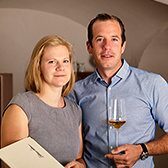
Restaurant
Matthias lives for the restaurant. In 2013, Elke and Matthias took it over and shaped it with their personal touch.
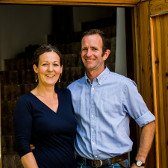
Winery & Guest Rooms
Fritz is passionate about agriculture and viticulture and converted the farm to Demeter. Birgit conjures up the delicious organic breakfast and takes care of the guests.
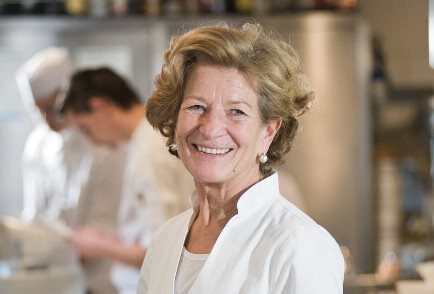
Restaurant Founder
Their love for good food gave rise to the restaurant in 1987 — evolving from the Heuriger at the estate.
Passion for diversity
The combination of agriculture, viticulture, and livestock farming has always been the logical form of management for the estate. Eva Salomon's love for good food led her to open a Heuriger at the estate — the simple cold kitchen quickly developed into a restaurant that is now among the best in the country.
Culture & History
Since the 12th century, wine has been pressed here — and the traces go back much further. A journey through almost four millennia of Gut Oberstockstall.
Early Times
um 2000 v. Chr.
During excavations beneath the foundation wall of the chapel, an Early Metal Age object is found — the oldest evidence of human presence at the Gut.
Bronze Age
1200–800 v. Chr.
A full-hilted sword, which dates from the later Bronze Age, was recovered in one of our vineyards.
Celts
vorchristlich
Traces of Celtic settlements in Kirchberg support the theory that the well on the estate, fed by three springs, was an ancient spring sanctuary.
Early Middle Ages
bis ~1100
The population in Wagram is initially predominantly of Slavic descent. With the expansion of ecclesiastical properties, a Bavarian "colonization" commences.
In Church Ownership
um 1135
Sigehardus von Stochestale transfers his estate to the Cathedral Chapter of Passau. The estate becomes the rectory of Kirchberg am Wagram and the seat of the Passau Cathedral Chapter's manorial lordship — it undergoes further expansion.
Church Property
1310/20
The Gothic chapel is built; with the altar above the well, the old spring sanctuary is Christianized. Its importance grows when noble canons from Passau reside here.
Church Property
14. Jahrhundert
The local parish priests simultaneously hold the office of Chief Cellar Master of the Diocese of Passau.
Renaissance
1538–1552
Domherr Christoph von Trenbach commissioned the construction of the current main building (residential wing) in Renaissance style. The Trenbach coat of arms, with the year and a scroll, remains preserved above the entrance door to this day. The alchemist's laboratory was also created during this period.
Renaissance
1590
The Neulengbach earthquake (magnitude 8 to 9 on the Mercalli-Sieberg scale) partially destroys the alchemist's laboratory.
Change of Ownership
bis 1803
Until 1803, the estate belonged to the Passau Cathedral Chapter, after which it passed to the Imperial Court Chamber and finally, for a short time, into the possession of the National Bank.
Salomon Family
1869
The salt merchant and ship owner Franz Salomon and his wife Elisabeth purchase the estate at auction — since then it has been in the family's possession.
Salomon Family
um 1960
A good six decades ago, grandfathers Josef Jamek and Fritz Salomon planted Gelber Traminer, Blauburgunder, Riesling, and Chardonnay in the Wagram loess, in addition to Grüner Veltliner.
Salomon Family
ab 1980
The sunken bricks Fritz Salomon discovered in the sacristy when he was ten years old were recovered starting in 1980: over a thousand objects — the most extensive inventory of its kind (Source: Dr. Sigrid von Osten).
Salomon Family
2002
Official conversion to organic farming of the entire operation.
Salomon Family
2008
With the transition to biodynamic production according to Demeter, the viticultural concept gains a new qualitative dimension.
A Secret in the Soil
At the age of ten, Fritz Salomon discovered the first traces of the "Alchemy Treasure". From 1980 onwards, over a thousand objects were recovered — the most extensive inventory of its kind: an alchemist's laboratory in "high-tech design" from the Renaissance, primarily for the examination of metal alloys and ore samples.
Tipp: By prior arrangement, the Alchemists' Museum in the former community center of Kirchberg opens — Guided tours with Dr. von Osten. Registration: info@gutoberstockstall.at
Wine, Cuisine & Hospitality
Discover the biodynamic winery, the seasonal restaurant, and our guest rooms at Gut Oberstockstall.